Short answer: below 2x you're usually losing money after product costs; 3 to 4x is healthy for typical eCommerce margins; 6x+ is strong. Across accounts we manage, our average is 8.9x, and our best long-term account documented 17.36x average across 162 campaigns. Your real target depends on one number: your gross margin.
ROAS only means something next to your margin
ROAS (return on ad spend) = revenue ÷ ad spend. A 4x ROAS sounds great until you learn the product has a 20% margin, then it's a loss. The formula that matters:
Breakeven ROAS = 1 ÷ gross margin.
| Gross margin | Breakeven ROAS | Healthy target |
|---|---|---|
| 30% | 3.3x | 5x+ |
| 50% | 2.0x | 3.5x+ |
| 70% | 1.4x | 2.5x+ |
Set targets above breakeven. Ads must fund growth, not just pay for themselves.
Our published numbers (unedited Ads Manager)
Benchmarks in this industry are usually anonymous survey averages. We prefer receipts from our own client accounts:
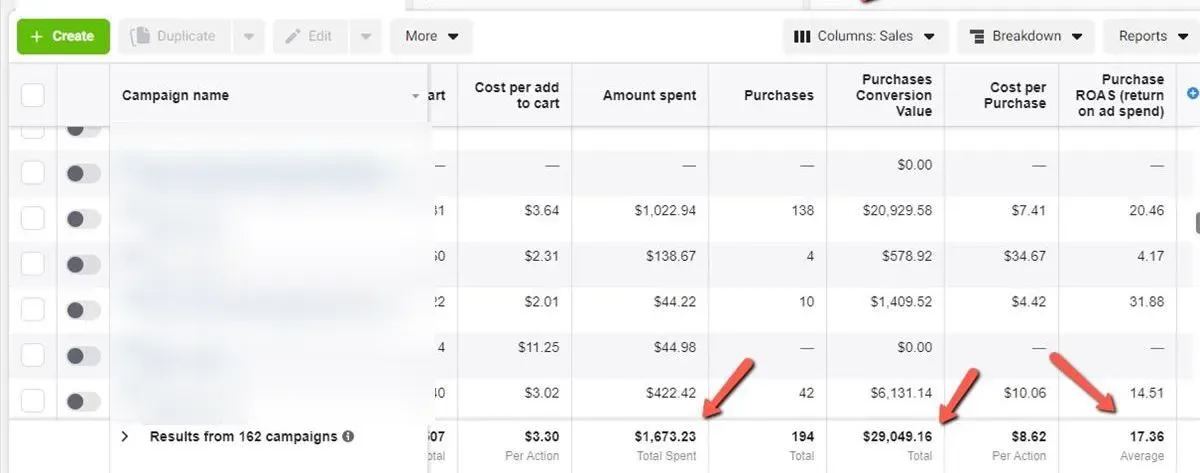
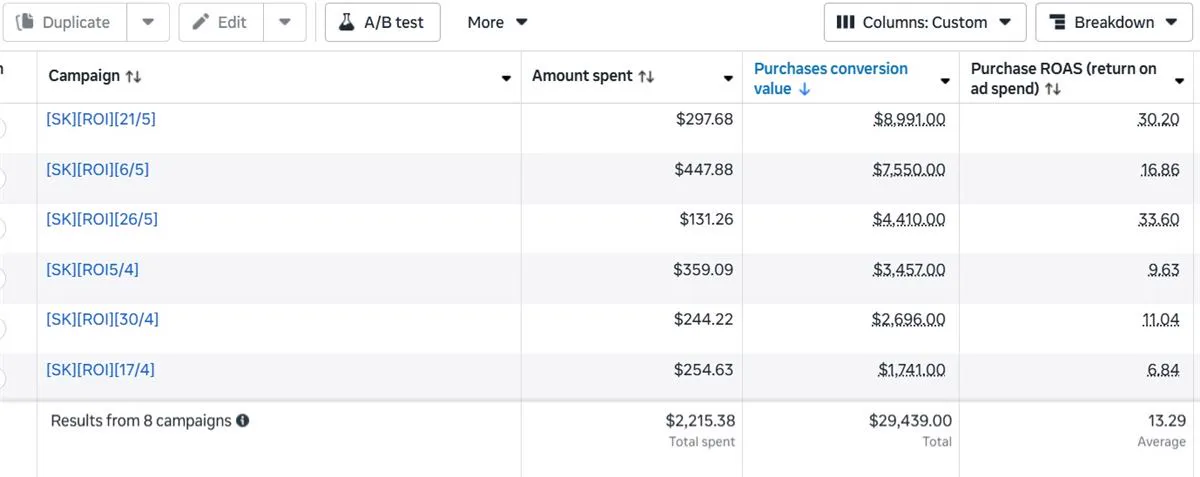
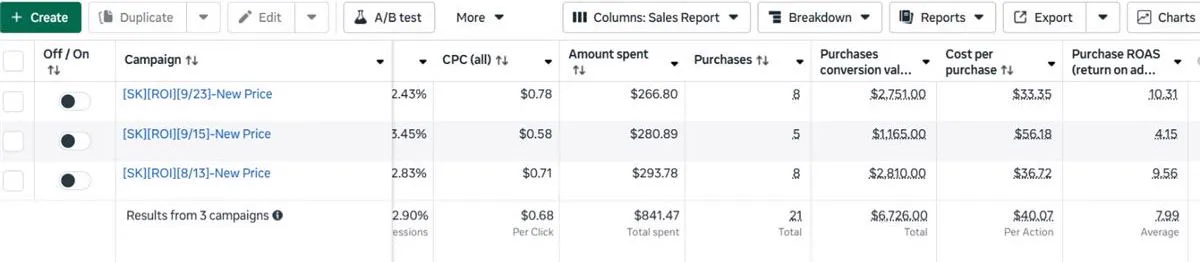
The honest range across our portfolio: strong months land 8 to 14x, exceptional runs reach 17x+, and ordinary months sit near 8x. Anyone promising a fixed ROAS before seeing your offer, margins, and website is guessing.
What separates 8x accounts from 2x accounts
- Systematic creative testing. In one fashion account, 15 audience variants were tested; 3 winners drove 78% of revenue and held 8.9x while scaling from $2K to $15K/month (12.3x peak during the holidays).
- Full-funnel structure. Cold, warm, and hot audiences each get their own message and budget, remarketing inflates blended ROAS if you let it hide poor cold-traffic performance.
- Accurate tracking. Pixel + Conversions API. If iOS conversions go uncounted, you'll kill winning campaigns by mistake.
- A website that converts. Doubling landing-page conversion doubles ROAS at identical ad spend, which is why we treat web design and media buying as one system.
Benchmarks by business type (from our accounts)
| Segment | Realistic early target | Mature account |
|---|---|---|
| eCommerce / DTC | 3 to 5x | 8x+ (our avg: 8.9x) |
| Local services (by lead value) | 4 to 6x equivalent | 13x+ documented over 6 months |
| Considered purchases (high ticket) | 2 to 3x in-platform | Higher after offline close attribution |
Frequently asked questions
What's a good ROAS?
3 to 4x is healthy at typical margins; 6x+ is strong; our managed average is 8.9x. Compute your own breakeven first: 1 ÷ gross margin.
Why did ROAS drop when I scaled?
Normal auction physics. You're buying past the cheapest converters. Scale in 20 to 30% steps, refresh creative, and add new segments instead of overloading one ad set.
Is ROAS right for lead-gen?
Track cost per qualified lead and cost per booked job instead, then work back to revenue using close rate and job value.